Showing posts with label Bryan O'Regan. Show all posts

Monday, December 22, 2014

Sprout hits the shops!

In the shops!
The good news is that the first batch of Sprout are being sold at a real life shop in the heart of Shoreditch. The place is called Type East and is located on Sclater street off Bricklane. More importantly, it is quite close to the newly opened 'Cereal Killers' breakfast bar which has split the opinions of hip-stirs all over London. By working with Type East, the product can be tested on strangers and the shop staff, Rich and Robin. Asking price is £20.


Packaging
 

Packaging

Two companies in China produced the packaging (sleeve and soil packet) and laser cut parts (wooden and plastic pot pieces). There were quality issues with the logo and the glued sleeved. Other work included buying the soil and seeds from a local shop near Columbia Road and weighing out the stuff into bags and small envelopes. The seed packets were labelled by Aindri showing a selection of Water cress and Marigold.


Sticker instructions v2


Instruction labels

Instructions shown on the right were printed on white stickers and stuck to the packet. Stamps made from a lino screen print kit were made up to label the different sections. This was difficult! 


Website

Work has started on the website using a template from Squarespace.com and will support a Kickstarter campaign. The photos below were taken inside and then edited in Photoshop with a blue filter to cancel out the yellow light from the lamp. Help also provided by 'O'. Taking good photos is difficult!

Wednesday, August 13, 2014

It's Sprouting! Updates on the Sprout development project.

I have been working with Andy on a new planter pot product called Sprout, a flat pack planter which will come in a neat DVD-sized packet with seeds, soil, sowing instructions and a wooden pot that is assembled by the user. Kind of like the IKEA of the planter world. It has been in development for the last couple of months (as a break from the job search...) and is slowly but surely bearing fruit. 

The London Hack Space - my new home?

I used the laser cutter at the London Hack Space, probably the coolest space around with numerous tools, gadgets and stuff, all for £15 per month membership, open 24/7 and a good atmosphere.

Soil comes in a packet
Some changes need to be made to this prototype including changing the sprue arrangements, cutting some more windows in the packaging, adding instructions, removing twine from the soil packet and adding an inlay to prevent the wood from warping. We will print the instructions inside the soil packet to save on paper. I wanted to use a plastic packet for the soil so that it could be seen from the side but as I wanted to avoid using plastic and minimise packaging, I decided to go for a thin card packet.

Working on a Kickstarter too and business plan (Andy's expertise!) and are on track at keeping the sale cost at around £10 each.


Bidoooo - update

In the last post I was chatting about Bidoooo and soon I will be releasing it to the wild in order to check whether it will actually satisfy a need. Oisin sent this great article for inspiration; 'How To Validate Your Business Idea By Testing A Hypothesis!' I thought I would start now with you, so please check out the landing page and let me know what you think: Bidoooo app

Cheers,
Bryan
hello@suiledesign.com
uk.linkedin.com/in/bryanoregan/

P.S. Know of any product development jobs in London for a MSc in engineering design?! Let me know!


Wednesday, July 9, 2014

Some work needing some work


This is the first thing I have written since coming to London. The change of pace from Copenhagen has been difficult to adapt too. Every time I step outside the door, it's some new adventure. As I look for jobs, I have been trying to work on some projects.


Ceramic cutter arm on top

Bottle cutter

There is an abundance of material which is sitting around and could be used to create anything e.g. aluminium cans, newspaper, bottles, fag butts (?)...I thought I would start with wine and beer bottles. With a little help from Instructables, I built version 1.0 of the Bottle Cracker because right now the glass keeps cracking. From Youtube I found that to break the glass, you pour boiling water on the crack, followed by cold water (keep doing it until the crack propagates). So far the results have not been great but I think I need to secure the cutter section more and fix the wheels.


Laser wooden pots

TopPot

Currently working with Andy on a plant pot for kids which comes flat packed with all the 'ingredients' (soil, seeds) and instructions. The idea is to get the kids involved to the point where they connect with the pot (not physically). Hoping to make a prototype soon.


Chair and table/foot rest

Furniture

So I had an interesting experience with a furniture company here in Shoreditch. Sadly, I parted ways as the job description was not what I expected. But I really like furniture and it was a cool company. The idea of modular furniture that packs away neatly (especially when you have a small living space) gives me great pleasure and joy.


This app...OHHHH this app!

Android development

I am no programmer but over the last few weeks I have been dabbling in some code using the online training platform codecademy.com. Tried the Python course and now I am working on HTML/CSS in order to redesign the City Music Tours website. I am very excited about working on apps and as I have a shitty Samsung, I thought I would try Android OS by following the Android Developer training instructions. This has proved to be a headache and at this point I have re-installed the ADT (Android Developer Tools) around 4 times. The funny thing is, the app worked fine the first time round. Hopefully with the help of a very intelligent programmer, I can get this Bidoooo app working.


Tiling
Red lines on white tile

After walking past a gallery in Mayfair and seeing some abstract art, I decided to have a go at it. I found some tiles in the house and did some abstract stuff. As my friend pointed out, most of that abstract stuff seems to sell according to size of the piece. This piece is 7m x 7m...any takers?

Tuesday, March 11, 2014

Solid waste management in humanitarian response

Collection, transport and disposal...
The last couple of weeks have been hectic as I make the transition from Copenhagen to London. I have set up a LinkedIn group for the Open Innovation Collective and so far there are 12 members.

We have started looking at a particular challenge; solid waste management in humanitarian response from the Innocentive website and sponsored by the Humanitarian Innovation Fund. You can find a presentation on the problem below which we have made to summarise the challenge:


We are currently at the brainstorming stage of the solving process. The presentation will be updated as we go along. Join the LinkedIn group and help out because if the idea is good enough, it could get tested in the field. Oh and there is a reward too...

Thursday, February 20, 2014

A puzzling process?

There are many issues to consider when trying to establish a method for solving open source problems. This is a new organisation, so there will be teething problems as we all try to create an effective solving process.   

Different work cultures, time differences, communication tools and member schedules need to be considered and are just as important as finding problems that interest and motivate responses from the group. At the first meeting we discussed what parameters should be considered in the selection of open source problems:
  1. Subject - how should a problem be selected so that it would be interesting and engaging for members of the group with different backgrounds, skills and interests? To begin with, a selection of problems from Innocentive and NineSigma will be made at the discretion of the moderators and presented to the group.
  2. Time - how much time should be dedicated to a problem? Submission deadlines are provided by the open innovation websites and group members will be notified.
  3. Responsibility - who should have what responsibilities?
  4. Communication - how should the solution be processed and presented?

The OIC solving processBETA

OIC solving process
As a starting point we have developed a solving process with the following steps:

  1. Present - a selection of problems is presented to the group
  2. Group vote - users like or dislike the problem on LinkedIn group.
  3. Brainstorm - share ideas, networking suggestions (who do you know who might help?) and ask questions! 
  4. Delegate tasks - who does what and when for the next phase?
  5. Homework - problem investigate and solution space created
  6. Feedback/knowledge share - insights and potential solutions presented to the group
  7. Define solution - Solution defined and tweaked
  8. Submit proposal to website.

Coming up in the next post: a selection of open source problems for us to chew over.

Monday, February 3, 2014

Render me a Wino

In order to communicate ideas more effectively, I wanted to teach myself how to render. I have experience in AutoDesk software but when designing, I normally sketch on paper and move as quickly as possible to Google SketchUp. Rendering involves taking a 3D model and adding textures and effects to create an image which looks close to the real thing.

The Wino 

Wino close up (click to enlarge)
At the moment I am working on a packaging design called Wino. I hope to create a design that can be easily fabricated using injection moulded plastic or ceramic and can present high end beverage products in an attractive and intuitive to assemble container/vessel combo. It could be used for serving alcoholic beverages like wine and champagne or fruit juices on airlines and trains where space is tight. The image on the left shows how Wino could be displayed and converted into a drinking container. Obvious problems include:
  • Packaging material - an attempt was made to create a black matt finish in plastic or ceramic. Plastic is easier to mould but has a cheap look whereas ceramic would look classier but costs more. Both could be recycled but this would depend on the recycling facilities available. Plastic could chip during filling and while in use.
  • Labelling - the orientation of the packaging means that while on display, logos and text (like the MOET logo shown) would be upside down. 
  • Beverage foil cover - to avoid contamination, a cover could be added. If the foil is not present, there could be drips of beverage dropping from the base when it has been put in place. A foil, heat sealed cover would provide another surface for different printed information such as the best before date and content info although it would mean further waste.The cover/base and vessel could be sealed with tape which could eliminate the need for a foil cover.
  • After/during use - unless the container could be sealed after and during use, there is the possibility that the product would leak beverage if taken apart and re-assembled to it's display state (left position in above image) .  

Render test

SketchUp (top) and Indigo render attempt
The aim of this exercise was to render a 3D sketch. I downloaded a trial of Indigo Renderer and installed the Plug-in on Google SketchUp version 8. In SketchUp, it was necessary to select each component (3 in all and an extra liquid meniscus layer component for effect) and edit the material so that they diffuse light in different ways. In the SkIndigo editor tool, it was possible to select different material presets such as glass or ceramic. For a matt black plastic look, I went for 'Leather' as it seemed closest to what I wanted. There were many other options but I decided to fire ahead and see what would come out the other end...   

The image on the right shows a comparison between the SketchUp drawing and rendered image. It can be seen that the shadows have been removed in the Indigo version, the colours have softened and there is an almost blue tint on the image. It has obviously gone wrong somewhere as the plastic has turned blue! Back to the drawing board...

Monday, January 27, 2014

Big data knows best

Electroencephalogram (EEG)
In 2012, as a student, I signed up as a human guinea pig for a neuro feedback experiment at the Danish Technical University, where 'we will study the effect of a neuro feedback by training the power in the upper alpha frequency band'. Over 5 days of one hour training sessions, I sat each morning in a dark, soundproofed room and looked at a bright laptop screen displaying small block patterns. It looked like a slow motion version of Tetris in zero gravity. A wireless apparatus was placed on my head which contained sensors and these were reading levels from the upper alpha frequency band of my brain. The aim, as far as I was concerned, was to focus on the patterns and concentrate on thoughts which affected the blocks and changed their colour from blue to red. I found this very difficult and various thoughts on different topics, including eating food, playing sport, playing music, playing sex etc. resulted in inconsistent developments on the screen. A pre- and post-training comparison involved some visual problem solving and the thesis student I was working for hoped to show that cognitive ability can be improved with 'brain-training'. I, it seemed, had done worse as the week went on...but my low brain activity is not the focus of this article. Here, I will review some evolving technologies relating to big data including biosensors which can use your brain signals to operate electronics, online shopping websites which will deliver goods before you make an order and contact lens that can read your sugar levels.

Neurowear

Neurocam
In November 2013, I attended a lecture at CPH:DOX called 'Emotional Interface: Bridging the Gap between Physical and Digital' given by Tomonori Kagaya, founder of Neurowear at the Danish National Gallery. His group are developing commercialised neuro headsets including the award winning 'Necomimi', 'Neurocam', 'Zen tunes' and other electronic devices which sense changing frequency patterns in the brain to activate different gadgets. An interesting example is the 'Neurocam', which consists of a headset and camera. When we look at different things, our brain reacts; when we look at things we like, our brain will emit signals which are picked up by the sensor. As we walk down the street, the camera is activated when signals are emitted and then at the end of the day, you can look back over the images and be reminded of your exciting day. This gadget is tapping into the signals that we are sub-consciously emitting. If we bring that concept one step further, we could be seeing wireless sensors in the future that can sense changes in the signals emitted by our brains. Just like the evolution in broadband which saw WIFI replace the need for a physical cable connection, these gadgets will evolve to the point where sensors in our smart phones or other devices can read our brain patterns and a new big data source is born.       

Smart bio-sensor contact lenses

Smart contact lens
Recently, Google[x] labs released news about the development of a smart contact lens that can be worn by diabetics and could mean the end of pin-prick glucose level tests. This smart lens contains a micro-chip and glucose sensor which monitors sugar levels by taking readings from tear droplets and transmitting the data wirelessly to a nearby receiver. Another example of a smart contact lens currently in development is one which will allow doctors manage glaucoma, the second major cause of blindness in the world. The sensors in this lens can read the pressure within the eye and if the pressure gets too high (a symptom of glaucoma), doctors can be warned in advance and carry out corrective procedures. As the components in these devices get smaller, cheaper, more flexible and sensitive, they will become more advanced and begin collecting further information about our bodies to add to the big data machine.  

Buy before you try

Amazon have been developing a lean logistics delivery model called 'anticipatory shipping' which will use the consumer data they collect, including past buys, your 'likes' and even where you click your mouse on their website (mouse tracking), to predict future purchases. The patent for this process has been in development since 2012 and the system would work by sending out anticipated orders to unspecified addresses in the hope that purchases of that same product would be made while in transit. Then, in transit, a specific address would be given to the parcel and it would be delivered to the consumer in what would seem to be a very short period of time. If Amazon's algorithms improve further to take into account user trends, demographics, shipping costs and developing sources of big data, we could watch and enjoy a trailer of some newly released DVD, and 30 minutes later, it is in our hands.

Big decisions

Big data knows best?
The above technologies are described very basically to support my previous comments on big data and the future of how we make decisions. As further technologies emerge such as neuro headsets and smart biosensors, and algorithms continue to churn through the data collected by these devices, predictions made about our needs will be closer to the truth. As scientists and engineers continue to unearth more about how and why we make decisions, how could big data be used to satisfy our needs? As the feedback from our bodies and minds supplement any big data decisions made, we could be certain that big data is making the correct decisions for us but might we begin to rely on big data and other supporting technologies to the point that 'Big Data knows best? 

Thursday, January 16, 2014

Let the games begin!

Spanner
It's 2014, I am 29 and looking forward to a new adventure this year; I will be moving to London to start my career as a grown up. So what better way to spend my spare time (after job searching of course, A-Kasse!) than to write about some things I have been excited about in the last few weeks. I hope to write about different things including the following over the next few posts:
  • Python and learning code with Codecademy
  • Rendering 3D models using Google Sketchup and Indigo
  • Open Innovation Collective and collective problem solving (with emphasis on biomimicry design methods)
  • The job hunt - am I the hunter, am I being hunted or am I waiting to be served?
They will be short and to the point, I promise.

Sunday, January 12, 2014

Nature Calls

Inspiration from nature...

Biomimicry is a word which deserves more buzz than it gets these days. Biomimicry is the discipline of applying nature’s principles to solve human problems in engineering, business, architecture and potentially any other area. Biomimicry can create links between different disciplines as the 'all rounder' science where biologists, designers, innovators and economists can all benefit hugely from a little thinking on the wild side and embrace over 3.8 billion years of evolution. However, a challenge for those interested in biomimicry is tackling the huge world of information out there relating to the field including biology and chemistry. But fear not, although it can be a daunting task, there are sources out there to assist the budding biomimicist.

In 1997, Janine Benyus authored the must-have novel on the subject called 'Biomimicry - Innovation Inspired by Nature'. Since then, she is seen by many as the poster child for the implementation of biomimicry in design practice today. Her book covers many different areas including agriculture and architecture and explores some of nature's masterpieces including photosynthesis in plants and natural materials and processes which engineers can only dream of creating. After this read, you will be left thinking about the world of ideas out there and why so much funding goes into research when potential solutions could be in your own back yard.


Once the seeds of inspiration have been sown, collecting data and facts could be next step. The Biomimicry Institute provides a great resource on www.AskNature.org called the Biomimicry Taxonomy; a database of over 1,500 organisms, animals and insects and how they have met different challenges in nature through different ingenious strategies. It is a great source of information and inspiration for designers but what are some examples of nature being used to inspire solutions in the world today?

Packaging material using mycelium
EcoCradle is a new material being developed by award winning design company, Ecovative, which could provide a substitute to polymer packaging like polystyrene. Mycelium is the active ingredient in the roots of mushrooms and when grown with the by-products of agricultural processes such as buckwheat husks, it can be shaped and formed into shapes. The process can take up to 7 days in a dark environment and requires no petrochemical inputs. Heat treatment is used to prevent any mushrooms from popping up unexpectedly . The result is a biodegradable and eco-friendly material which matches many packaging solutions in use today. Further development could mean greener material options for use in insulation and anywhere there is a need for foam-based products such as turbine blades and building materials.


Inspiration for self-cleaning glass
Work at MIT has resulted in a new process for creating surfaces which found its inspiration from the Lotus leaf and the complex nanoscopic architecture found on the eyes of moths and the bodies of certain insects such as desert-beetles. These multi-functioning natural materials are self-cleaning and it was this property that attracted scientists to investigate further. Through the application and careful etching away of nanoscopic material on a surface, patterns can be created which can prevent reflection and repel water. Further development of the process could lead to improvements in photovoltaic panels, video equipment, mobile phone applications and of course, windows.


If the above does not whet your appetite, why not check out some more examples below:
Examples of Biomimicry in Action – article by Jaymi Heimbuch for TreeHugger.co
Biomimicry Europa – non-profit organisation promoting biomimicry in Europe
The 15 Coolest Cases of Biomimicry – a list of current applications and development work in the field of biomimicry .

This article was previously published online on http://www.innovationpioneers.net/nature-calls

Monday, January 6, 2014

A future with no decisions.

Words like innovation, green, design, up-cycle, entrepreneurship, creative etc. are used like they are going out of fashion. It took me some time to realise that for the most part they are meaningless words used by businesses and people to sound trendy and look like good guys. There is one 'buzzword' however, which I find very interesting and it is 'BIG DATA'. Not usually written in capitals but it should be, I think. I am no expert in the term but perhaps some of the below might clarify something about big data and what makes it interesting to me.

You might remember in the last US election a guy called Nate Silver who was a blogger and actually did a good job of predicting the results of the US election using mathematical models and statistics. (You can find more info here). That same guy has used past data and math models to predict the outcome of baseball and poker games quite successfully. Methods like these are used by bankers, farmers, weathermen etc. to predict future outcomes, so nothing new there.

Big data is the term used to describe all of that information collected about social network users which includes their 'likes', searching habits, what they eat, where they are (e.g. GPS location and Foursquare) where they are going (various flight booking websites) etc. It might not be restricted to social media data but most people are happy to share this information as it is fun and convenient. They might not necessarily know how this data is used or how it could be used in the future because technology is moving so fast, it is hard to keep up with IT legislation which 'protects' users. It is hard to create legislation for something which is not defined to begin with. Some people are doing research on this issue and how to give users more 'rights' and tools to protect their information and how it is used (interesting articles on this here). For now though, it seems that big data is open to the world and they are inferring or predicting some interesting issues from this data.

To die for.
Facebook and Google have been using search results and big data to be where they are now. At the consumer level, Google is doing well promoting products and services (music, images and video through YouTube) that suit your tastes. From search results, Google can put adverts on a page which are likely to suit your preferences from past searches and online activity. So rather than getting an advert for a pink sequin Dior diamond encrusted Nokia phone, I should be getting a black bullet proof phone of some sort which is cheap and reliable for example (yayyyy!). Supposedly, Facebook can now predict your sexual orientation with 88% accuracy based on whether you like Britney Spears etc. (more information on that crazy idea here). So if you liked that video of Bob Dylan, read that article on the Guardian, booked that flight to Istanbul, read that French article on Sarkozy or had a gander at McEntee winning the Meath election in Ireland, all of these 'data points' could be used statistically to predict or infer something about you. It might not be trying to sell you a product directly but could be used to improve your internet experience in order to make you buy something eventually for example. I find this area to be exciting and also very scary but I am not arguing here whether it is right or wrong.

It is hard to define how, why and who collects data or whether it is a by-product of the internet where data has been hoarded and not used 'effectively' until now. With open information and the continuation of big data gathering as we know it today, let us imagine a scenario. It is 2050 and I come home in the evening and I am hungry. I get to the fridge and open it up to find a fresh stuffed chicken, some 'taters and beans. Perfect. I turn on the telly and my favourite TV show is on that I have not seen in ages. A message pops up on the screen to say that I have a flight booked to visit family some place and concert tickets have been booked for a concert I wish to see (at a cheap price). Suddenly, a video pops up of the election results and I am happy with the results because Jessica Delquenta got elected to the Dail as Taoiseach.


Molecular robots (image credit)
In 2050, your data and online habits are used to predict what you want and when you want it. Since you were young, a biotech microchip has been 'installed' in your body which can read various chemistry such as sugar and serotonin (believed to be one of the chemicals which alters our mood) levels for example. It allows your doctor to ensure that you are healthy and fit and can also be used to predict what your body needs or wants such as a stuffed chicken in the evening (or constituents that make up chicken and satisfy your bodies cravings). In this 2050, you don't have to make any decisions yourself because big data is used effectively to do it for you. There will be no elections as we know it today and people will not have to vote. 'Big data' will make the decision for you and it will always be right or 'feel' right to you. If it is wrong, you or your body dislikes it. No more pink diamond phones. It won't be a cut off world where we are just individuals using Facebook and staring at the world through a screen. Your environment will adapt with your needs and 'likes' and will allow you to spend less time making wrong choices!

Does this mean an end to 'choice' as we know it? Depending on how you define choice, this system could work very well. Imagine in 2050 that the next level of big data gathering works offline as well as online. With biotech, we have the ability to measure responses in our body due to external stimuli, for example; diamond phone makes me unhappy, keeping the elderly off the streets makes me happy. It knows your political preferences and knows that the elderly is a big issue for you and can predict who you would elect for government to improve conditions for the elderly etc. Can big data be used to make more informed decisions for you?! My way of life, interests, habits, health, relationships etc. can all be used to predict what I 'want'. Are we unknowingly, through how we live online, transferring the need to choose and make decisions into the hands of big data? Is it already happening now?

Monday, October 21, 2013

What now?!

Lizard dance celebration (Photo credit)
This will be the final blog post in this series as I have now graduated as a MSc in engineering design and applied mechanics. Wooop! In this post I will report on the work carried out between handing in and presenting my thesis. I will summarise the feedback that I received and then list some practical advice for those interested. 


Heat pipe with luer and end cap

Final work

In the last 10 days before presenting, I felt it would be worthwhile to try and charge/seal the prototypes and then thermally test them. However, I was never able to evacuate the heat pipes correctly or seal them after the charging attempt. It was pre-mature going ahead with prototyping and it would have been better stopping sooner and writing up on the results, even if it meant that the heat pipes were not created.


Testing set up (HP highlighted in red)

However, regardless of the seal, I still wanted to go ahead with the testing to see what kind of heat conductivity I might get out of the prototypes (stubborn). I set up the apparatus as shown on the right, with the heat pipe clamped gently in the heater (the evaporator end) and a fan set up at the condenser side (to focus the flow, I made a cardboard box element to focus the flow - left image). It was necessary to deflect the forced cool air from the hot end and so a guard (aluminium foil) was placed between both ends. As the HP was not filled correctly, the applied heat only increased the temperature at the hot end and there was an accumulation of heat there. After reaching around 90 °C, it was removed and it was observed that the Si seemed to warp. The results were not conclusive but due to time limits I took some readings using a laser infra-red thermometer which was awkward due to the experimental set up. This was a good example of how not to run an experiment...


Feedback

Although the literature review and presentation was good, I lacked enough analysis and structure relating to the experimental results. I should have focused on the wick structure element and characterised it more thoroughly, perhaps by comparing it to other wick structures currently available. I didn't persuade the examiner that by further investing effort in a lizard inspired wick surface, a more effective and economic solution could be found for the cooling problem. But the biggest rookie mistake I made was that I did not summarise clearly the results of the hypothesis in the summary. These were expensive mistakes...


Final words of advice

Here are some final words of advice which might help you out: 
  • Create a deadline for when to stop creating new data, finish experiments, develop prototypes etc. Focus on the analysis of the work you have done to that date as you will be more thorough and scientific in your analysis. I would suggest stopping 3 weeks before you hand in the thesis. I found this hard to do...
  • Present your supervisor with bullet point lists of what you have accomplished every week in a paragraph. Less is more for these busy people!
  • Order parts and components early in the process and make sure you have funds (ask your supervisor). However, I would suggest only ordering parts when you know they will work...or at least are nearly sure they will!
  • You have to hand in the thesis in hard copy and electronic. I think the number of hard copies vary depending on the department/supervisor and number of examiners.
  • The presentation can last 30 minutes. After this, there is a round of questions which lasts approx. 45 minutes. There can be questions from the examiners (two in my case, one being my supervisor) and I also had a question from a member of the audience. I don't think that inviting guests is of any benefit to your presentation but then again, maybe you might feel more like a rock star. You are then asked to leave where they will make the judgement.
  • I had too much to say during the presentation and although I practised it with a friend beforehand, I felt I was rushing through it. The feedback on the slide show was good but I think that I should have reduced the amount of content and chatter. You can find the presentation below (Prezi of course):


Thank you/mange tak!

Thanks for reading and keep in touch with me through LinkedIn: 
dk.linkedin.com/in/bryanoregan/ or visit my website: www.suiledesign.com - always interested in collaborating on projects when I can. Good luck! Bryan.

Tuesday, August 20, 2013

Charging and sealing the prototype before the big day

A selection of the FMHP prototypes
Last week I handed in my thesis one hour before setting off to Cork in Ireland for a family holiday. I now have to send in two hard copies to my supervisor from Ireland. My defence is on Thursday 12 September but before then, I have to get the prototypes working. I return back to Copenhagen on Monday 10 September which leaves very little time to fix some big issues including:
  1. Charging and sealing the flat micro heat pipe (FMHP)
  2. Setting up the equipment for testing the heat transfer capabilities of the FMHP and working out the overall thermal conductivity of the prototypes
  3. Organise the data and compare to literature 
  4. Putting together the presentation and other stuff that I hope to use for the defence.

Leak tests

I set up a simple leak test to check whether the glue had worked on the prototype FMHP. I set up a test as shown in the image below, sucking out the air, closing the valve and then dipping the end of the tube in water. Opening the valve allowed the water to be sucked through the tube, hence proof that a vacuum existed. However, there could be slow leaks, given time, would relieve the pressure - to be sure, I added an extra layer of sealant. 
 

Leak test set up (red areas show potential leak points)

Charging and sealing

Each prototype has an inlet consisting of PTFE tubing with 0.6 mm outer diameter. I am going to attempt to fill/charge the FMHP using a syringe vacuum technique. I will try to evacuate air from the FMHP, then use the internal vacuum in the FMHP to suck in a volume of fluid which should wet the wick section. Then I will crimp shut the PTFE tubing.

FMHP charging set up

The biggest headache thus far has been figuring out how to crimp the FMHP shut. I have tried different methods and tested the crimp by flushing air through and watching for bubbles in a water bath.

Needle inserted in PTFE tubing and crimped - FAIL.
So far I have tried three different crimping methods and they have all failed:
  1. Metal sleeve crimp (as in the last blog post) - this cracked the PTFE tubing and leaked
  2. Needle crimp - I inserted a steel needle into the PTFE tube (applying glue) and then crimped the steel. I tried a number of crimps, at different angles on the needle but it still leaked. Out of five attempts, one seemed to hold but there was still some air bubbles visible at the outlet. One small bubble seemed to just stick at the end of the needle and I am not sure why this happened.
  3. Tube bending - I tried to bend the tubing 180 ° and tie the tube in this position but it still leaked.
I am now looking at finding a Teflon sealed adaptor or something that will allow me to inject fluid and then pull out the syringe without losing vacuum pressure and/or fluid. Hopefully someone at DTU Nanotech can help with this.

Testing equipment

Once filled and sealed, I will have FMHP ready for testing. With testing, I will have to apply heat at one end of the FMHP over a small area and then measure the temperature at the other end in order to calculate the over all heat transfer. Practical considerations for the experimental set up will include:
  1. Heater with controllable hot plate that can preferably apply a controlled amount of heat to the Si side of the FMHP. This might involve creating a metal shim 1 cm² in area and surrounding it with insulating material so that heat is focused on a particular region (as in a CPU cooling situation). A thermal insulation paste will be needed to create good contact with the FMHP.
  2. Thermometers to read the temperatures at different points on the heat pipe. It will be necessary to glue the thermometers which means I need approx 6 per FMHP prototype - 2 at the hot end (evaporator), 2 at the centre (adiabatic region) and 2 at the cold end (condenser). They will have to be glued (i.e. one use only) so I will also need a conductive glue.
  3. Prof. Larsen suggested a water cooler at the cold end where the inlet and outlet water temperature can be measured (more thermometers). This will involve a structure design which will allow the end of the FMHP fit in securely and be water tight.
And this all depends on whether these prototypes:
a) Melt - PVC can start to soften at 100 °C so I have to keep the temperatures below that which is the case for CPUs which need a safe operating temperature of approx. 85 °C
b) Leak - Will the glue crack and let air in or will the tubing connections leak?
c) Crack under vacuum - Will the combination of heat and pressure crack the plastic? Are there hidden cracks in the Si from my disastrous labelling method (using a glass cutter on Silicon!)
d) WORK! 

Sunday, July 21, 2013

A quick update on lab work

The Polymic group have kindly allowed me to use their lab to carry out the heat pipe fabrication work. I have been running from the Polymic lab to the Danchip lab and then another lab at the Nanotech building looking for parts in order to create the prototypes and testing systems. I am trying to avoid ordering parts but it has been difficult sourcing the components I need. The literature I am reading is not very precise on what gauges should be used or the components and as these are unique prototypes, I have been doing a 'cut to fit' job.

Creating the prototype 


Last week I spent a lot of time trying to bond the container and Si section together using the silicon based adhesive. To be honest, I am really not sure the bond will hold because in order to prevent any glue from contaminating the wick, I tried to apply it partially to the surface. It was the clamped for approx. 24 hours where I then applied another layer. I will be doing leak tests this week so if they fail, I might have to open them up, remove the glue and give the parts a clean and glue with something else.


Clamped carefully with clothes pegs

On clamping with the clothes pegs, another Si wafer bit the dust. The clamping must have again agitated a fracture in the Si wafer after I scratched it with the glass cutter (Roman numerals with all those straight lines...a bad choice!).

Cracked prototype.

The tube system can also be seen above on the cracked prototype. It will be covered at the connections with sealant.

Contact angle tests

From the previous research, Simon had placed the Si wafer with micro structure in the Plasma chamber for a couple of minutes in order to create a silicon oxide layer on the surface, making it more superhydrophilic. I have done this for all of the specimens and have carried out some 'rate of rise' velocity tests on the specimens.

Oxygen plasma treatment of the wick structures.
Contact angle test of Si wick structure after plasma treatment. The drop spreads instantly (as opposed to the untreated specimen) which means the surface is fully wetted.

Crimping

I have tested a crimp system and perhaps I can get that to work. However, it will difficult crimping the tubing of the cotainer which needs to be under a vacuum. Once I source a vacuum sensor of some kind, I can test this set up for leaks.

Crimping the tubing

Next...

I have been also working on putting together all of the information into the chapters on concept development and heat fabrication. As time is ticking away, I am not sure whether I will get to the testing stage as there are still the huge tasks of leak testing, charging and sealing.

Wednesday, July 10, 2013

Roskilde and discos (on PVC)

A weekend volunteering at the Danish Corner at Roskilde has left me anti-pork and suffering from man-flu. But regardless, I got something done in the last 3 days. Tomorrow I hope to begin gluing the container together in preparation for filling and sealing. I hand in August 7. Yikes.

Wafer set up before cutting

Disco cutting

Today we finished cutting out the wick sections thanks to help from another Danchip employee, Majken Becker. The Disco saw danced through the silicon like M.J. doing the moon walk through butter. However, I lost a couple of sections due to some work I did on the pieces beforehand. In order to label the sections, I used a glass cutter to mark them with Roman numerals from I - V. Funny, I thought the Roman numerals would look better (classy) but the straight lines I scratched into the surface must have aligned with the crystals in the silicon and once sawing began, the crack propagated through the whole section. 3 out of 10 wick sections were lost in this way. AND while drying the wick sections after a dose in the ultrasonic bath (5 minute blast), I was drying them with an air gun and nearly lost another part after it blew out of my hands and hit the floor. Manflu.  


PVC plastic cover for heat pipe

PVC container sections

10 covers have been machined using a milling process. The material is PVC and was chosen because it was available and a quick calculation shows that it should be OK under pressures up to 2 bar with a wall thickness of 1 mm. A 1 mm diameter hole has been drilled in the centre for filling. I am not looking forward to filling and sealing. I will need to ensure that there are no other gases in the cavity and it needs to be sealed at the hole. The glue and hole need to hold when in operation.

Alicona image of cover wall showing debris

The milling process has left some debris around the edges which could contaminate the capillary structure. Even after 5 minutes in ultrasonic bath, there still appear to be leftovers from the milling so it might be necessary to sand these down. But then that could lead to further debris (finer debris) so I will probably go around the edge with a tweezers and pluck them off like hair from a brow.


Friday, June 28, 2013

Heat pipe cover materials

Yesterday was the 25th of June and according to my plan, I should have some heat pipes in my lap ready to be tested... Alas, due to busy schedules at DTU (some departments close for summer and people are taking vacation), it won't be until next week that I will be fabricating the different components including the etched silicon wafers (and cutting/cleaning) and the top covers. Still plenty to write about though and I have sent in a draft of chapter 4 relating to heat pipe technology (a literature review) to Torben. I will be adding a short chapter on my work methods and how I arranged my time, held meetings and put the project together. At this point, I have to consider the possibility (very real) that these heat pipes will not work and as my supervisor said, it is about the logical process and how you failed that is importa.... ah feck that! They better work!

Building the container

Yesterday I spoke with Jan F. Pedersen, who is the manager/foreman of the MEK production labs at building 427S at DTU. As before, he was very helpful and we discussed some issues regarding the milling of my parts. Three issues were clarified:

Milling depth - Depending on the time available, 10 covers will be fabricated. The vacuum cavity area of the heat pipe will remain at 1 mm high while the depth of the etch will vary. The milling drill head is 1 mm in diameter and had to be taken into account so that the covers would fit over the etched structures. A 1 mm hole will be drilled through the top of the container so that it can be filled.

Polyvinyl chloride (image credit)

Material - There are many different plastics available at the MEK building but it was necessary to go to the workshop to check out what was ready for milling. As discussed in the last blog the material should have high heat thermal conductivity and a low coefficient of thermal expansion. PVC was chosen as it is available but I think there could be problems with it.
  1. The thermal coefficient of expansion (E-6 mm/mm °C)  is 50.4 and for silicon is 3. Will the materials expand to a point which will create large stresses in the glue seal and rip the container?
  2. The thermal conductivity of PVC (W/m °C) is approx. 0.20 and 149 for silicon. At the cooler condenser end, it will be necessary to release the heat so this material will not be efficient at doing this. A suggestion from Jacob at the 3D Fab Lab at DTU seems the right choice: orientate the heat pipe such that the heat is released through the silicon side.

Sunday, June 16, 2013

Etching and micro-fab for this week

Summary

After a slight scare last week, a meeting at Danchip clarified some issues and made me realise that the error could be worked around. Again, I have had to make concessions with the design and pull back on some ideas that I have wanted to try out on the wick section to improve capillary action. With only a few days to go until I reach the experimental stage (Tuesday 25th June 2013), this week will be focused on etching the wafers, cutting them and machining the container cover. Then I will need to put it all together for the next stage: filling and sealing the container with working fluid before testing.

To etch...

I had a meeting with Karen Birkelund at Danchip which was very useful and allowed me to clarify what exactly I could achieve with etching considering the time limits and material I have to work with. She suggested that I could start from scratch and redesign the photomask (i.e. the layout of the lizard inspired wicks on the wafer) and create more workable structures. However this could take weeks. My desire has been to make do with what I have instead of spending more time and money (DTU's money!) on more material. However, in hindsight, after the time spent trying to figure out work arounds, it might have been more productive starting from scratch...c'est la vie!


...or what to etch


It has been confirmed that in fact, the 5 wafers that are in storage at Danchip have been treated with photoresist and were not etched. In the plasma etching process, although photoresist protects certain areas of the wafer, it is still actually being etched away, but at a slower rate to silicon. Depending on the depth of micro features, it can be necessary to use a thicker photoresist but hopefully in this case, I can avoid this process.

It has been an iterative process where the following etching concepts have been discussed and abandoned:

  • Depth variation laterally across the wick surface - this process has been not tested before at Danchip and it is feared that delicate equipment could be damaged. The application of Kapton tape to the wafer/photoresist surface could allow selective etching of certain areas but might also damage the photoresist when the tape is removed and prevent further etching.
  • Wet etch undercut - this would involve further training and although it could be an interesting result (mimicing the lizard more accurately), the creation of undercut channels would make mass manufacture using injection moulding very difficult as removal from the mould would destroy the structures. 
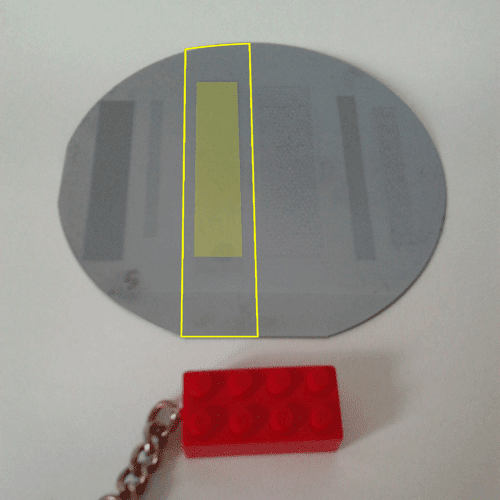
    Cut out (line) and wick area (shaded) 
    Cut out (line) and wick area (shaded)
  • Create heat pipe wicks from all wafer patterns - handling the wick pattern 'chips' will be difficult due to their small size and once made into a heat pipe container, creating a fill hole for charging and sealing would be very frustrating. Once etching is complete, there will  be 5 wafers of different etch depths varying from 30 to 150 μm. It has been decided that one wick 'chip' will be cut from each wafer so that a large enough surface surrounding the wick structure will be available to join the other container section (approx. 3 mm). The figure above show which sections will be used (shaded in red and yellow) and the cut lines are also shown. It will be necessary to cut out the 'chips' using a Disco cutting saw such that 5 chips will be available to create 5 heat pipe containers. They will then be cleaned and taken to the MEK micro fabrication department (building 427). Karen also suggested that 'blank' extras be made for practising the sealing process. Thanks Karen!

Container design 

Last week I spoke to Jan F. Pedersen who is the manager of the workshop at the MEK micro fabrication department (building 427) and was very helpful in his suggestions about the creation of the cover of the container and how it could be constructed. He said that it could be possible to machine a piece of plastic into a cover piece using a milling machine with a 1 mm milling tip (I need to confirm what he intends to use but hopefully I can get some hands on experience in this). It could then be glued to the silicon wafer wick section although this would need to be confirmed with the glue manufacturer (Loctite).


The following issues need to be clarified before machining begins:
  • Dimensions of container - although most of the dimensions will depend on the wick section area, the height of the container is very important as this will define the vapour section volume during operation. I still need to confirm the pressure drops across the container under different conditions and after reading that Benson et al. had designed flat heat pipes for a maximum pressure of 2 bar (!), my calculations could be well off (I have been thinking about pressures of up to 1 bar). The walls need to be thick enough so the container does not explode and rip off my face during testing (does anyone read this far?). The dimension of the fill hole will also be important but from the papers, 1 mm Ø could be OK but I need to clarify the filling and sealing operation also.
  • Material to be milled - the material will be a plastic and should be compatible with the working fluid (water). It should have a coefficient of thermal expansion which is similar to that of silicon so that when in operation, the silicon and cover will expand similarly. Cost is also important as it is hoped that both the cover and wick structure can be created in future using injection moulding so the cheaper the material, the better. The plastic must also have a high thermal conductivity such the heat is transferred through the material at the condenser end.
  • Bonding method - Jan suggested I look into the type of glue which could achieve a hermetically sealed connection under pressures of up to 2 bar, temperatures of up to 150 °C and also ensure that the glue does not break up over time (or during bonding) and contaminate the wick cavity. I emailed Loctite to enquire as to whether they have anything that might work. Otherwise, another bonding method will be used but as always, time is 'tite'...